
ADTC Release Paths
NJDOC is a statewide prison system, not the Middlesex County Adult Correction Center. A person sentenced in Middlesex Superior Court may leave MCACC when the state accepts the commitment. That county booking has ended, but state custody has begun. “County of Commitment: Middlesex” identifies the case venue and does not mean the person is housed in Middlesex County.
A later NJDOC departure can reflect parole, maximum-term expiration, another legal release, or a transfer outside NJDOC. Parole is community release under New Jersey State Parole Board conditions. Discharge means the relevant custody or supervision obligation has ended. The incarceration-history row, Date Out-of-Custody, and SPB information must be read together before choosing either label.
| Event | Correct record |
|---|---|
| MCACC to NJDOC | County Released Date/Time plus NJDOC Date In-Custody |
| NJDOC physical departure | Date Out-of-Custody in the correct history row |
| Expected sentence end | Current Max Release Date, treated as calculated |
| Possible parole consideration | Current Parole Eligibility Date and SPB process |
Confirm an ADTC Release
Open the official NJDOC offender search in a normal browser. The application may require JavaScript, cookies, or a security step. Search by name and use the SBI number when known. An SBI is the state identification number that helps separate people with similar names.
- Search the exact name, then try a documented alias or name variation if needed.
- Open the likely match and compare SBI, physical description, offense, sentence, and county of commitment.
- Read the current facility and incarceration-history rows. A current facility means the person should not be called released from NJDOC.
- Locate Date Out-of-Custody in the relevant admission. Keep it attached to that row.
- Check SPB when parole may follow, and use court or NJDOC records if the public result is unclear.
The Middlesex County release overview supplies the county, court, federal, ICE, and records-request paths when NJDOC is not the right system.
ADTC Release Search Fields
The official NJDOC field glossary defines the fields that distinguish actual history from a forecast. Identity data can include aliases, SBI, physical descriptors, county of commitment, case or commitment order, offense and citation, offense date, and sentence date and length. Sentence data can include mandatory minimum, maximum term, current facility, and incarceration history.
- Date In-Custody
- The admission date for the displayed custody episode.
- Date Out-of-Custody
- The historical date released from NJDOC physical custody.
- Current Max Release Date
- A current calculated maximum date affected by earned and lost time.
- Current Parole Eligibility Date
- The expected eligibility date under SPB calculation policy, not a release result.
A record can contain more than one admission, parole return, or sentence row. Never pull one date away from its row and combine it with another episode.
View NJDOC Offender Search
The official state offender search and historical-result interface is the correct public route for an NJDOC release.
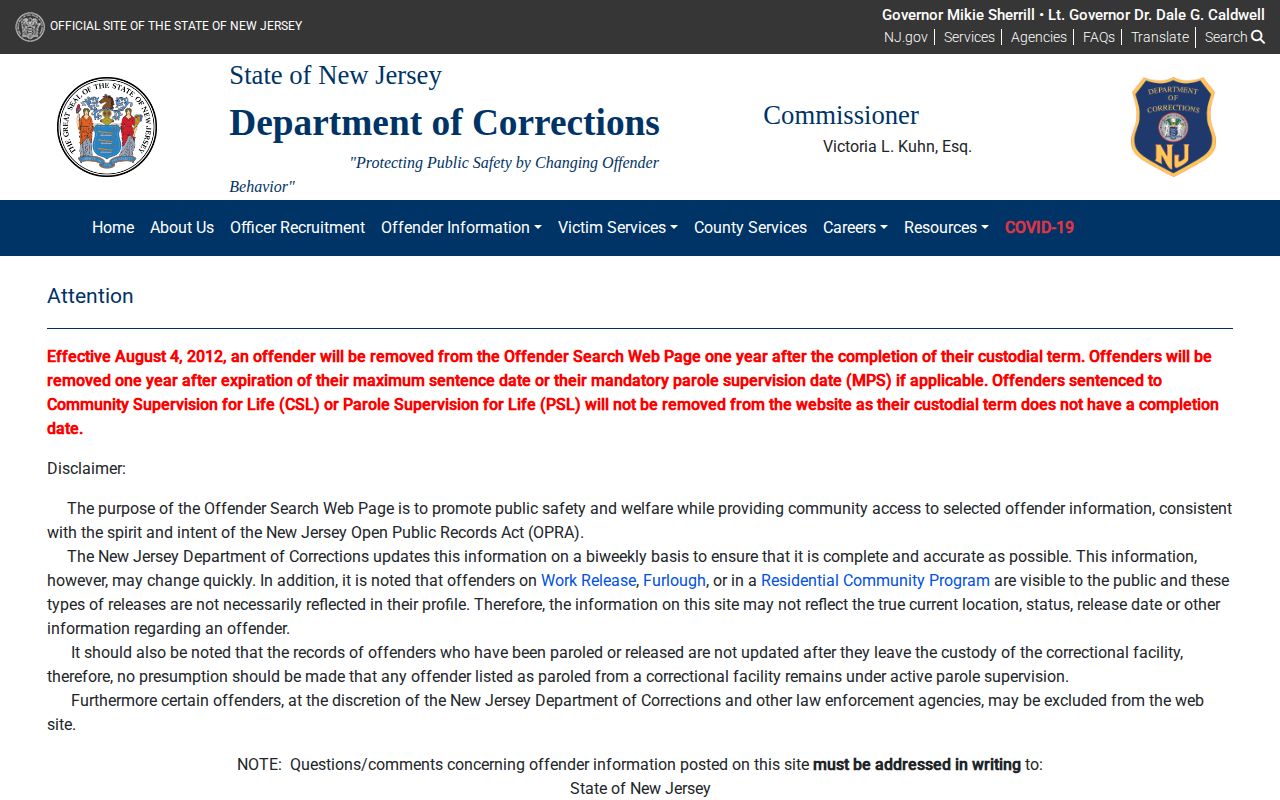
The screenshot shows the state source, but a live result must still be matched by SBI, sentence, commitment, and the correct history row.
ADTC Projected Versus Actual Dates
Current Max Release Date is mutable. NJDOC says it reflects days earned off the sentence and days added for negative institutional conduct, and it may change at month end. Current Parole Eligibility Date is another forecast. Eligibility means the person can reach a parole step under the applicable rules; it does not prove a grant or physical departure.
Date Out-of-Custody is the historical field. Even then, check the status and receiving authority. A person can leave NJDOC physical custody for parole and remain under SPB conditions. A different authority may also assume custody. A future-looking date should never replace the actual field in a past-release statement.
ADTC Records and Parole
Use NJDOC’s official records or OPRA route for a detailed state custody or sentence record. Identify the person by full name and SBI, then name the incarceration-history row, sentence, and field sought. For a disputed date, ask for the applicable calculation sheet or existing record rather than trying to correct it with public arithmetic.
For purpose-neutral parole verification, contact the New Jersey State Parole Board Public Information Office at SPB-Public-Info-Office@spb.nj.gov. No verified statewide public name-search database solely for parolees was found. District Parole Office 11 serves Middlesex and Somerset at 550 Jersey Avenue, P.O. Box 595, New Brunswick, NJ 08903, 732-937-6253, but private reporting schedules are not public lookup data.
NJDOC’s public web code states that most offender profiles are removed one year after custodial-term completion, measured from maximum sentence expiration or the MPS date. CSL and PSL records remain because that custodial term has no completion date. This is a web-publication rule, not an underlying records-retention schedule.
ADTC Releases and Detainers
The local transfer angle begins at MCACC. Archonix agency choices include NJDOC and U.S. Marshal, so a county Released Date/Time can mark the start of state or federal custody. When an NJDOC Date In-Custody follows the county exit, describe it as a transfer into state custody. Do not call the person released to the community.
If NJDOC later records Date Out-of-Custody, determine whether SPB supervision or another custody source follows. ICE’s locator includes people released from ICE custody within sixty days, but it is not an NJDOC release archive. No current MCACC ICE contract was verified. A transfer affecting one person does not establish a contract or broad facility practice.
Note: Receiving custody and supervision can survive an NJDOC physical departure, so the historical date is one part of the final status.
ADTC Specialized Record Limits
Adult Diagnostic and Treatment Center in Woodbridge and East Jersey State Prison in Rahway are the specifically mapped Middlesex-area NJDOC institutions. Other state prisons can also hold a person committed from Middlesex County. Facility location and county of commitment answer different questions. Search the statewide record first.
An internal move between NJDOC institutions is a transfer. The current facility changes, but Date Out-of-Custody should not be inferred from the move. ADTC’s specialized legal framework also means its name must not be used to infer an individual’s conviction or registry status. The public record for that person controls.
The state system’s address is not reduced to one Middlesex contact card because NJDOC institutions are statewide. Use the current NJDOC facility directory and the appropriate records channel shown by the official result.
ADTC Identity and Status Limits
The facility name cannot establish a person’s conviction, diagnosis, treatment history, registration status, or supervision condition. Match the actual NJDOC record through SBI, aliases, physical descriptors, offense, sentence, county of commitment, and admission. A similar name or known link to Woodbridge is not enough.
An NJDOC photograph is tied to the state commitment and is not necessarily the MCACC arrest image. The New Jersey Sex Offender Internet Registry is a separate source only for qualifying, legally publishable registrants. Registry presence does not supply the ADTC release time, and absence does not establish that no duty exists.
Protected treatment, medical, victim, security, sealed, and expunged material may be withheld. Read the offender search for fields it actually displays, not private facts inferred from ADTC’s specialized role.
Reconcile an ADTC Discharge
When an MCACC record says released and NJDOC shows a later admission, the county event was a state transfer. If the current facility or history identifies ADTC, the person entered state custody there or reached it through an internal move. Neither event is community release. Date Out-of-Custody is needed for the later departure.
An old Date Out-of-Custody and a future maximum date may belong to different admissions or sentence rows. Compare SBI, sentence date, offense, commitment, and exact history segment. Current Max Release Date is calculated and can change at month end.
If parole may follow, use SPB Public Information. If another authority assumed custody, check that authority. ICE’s recent-release tail and BOP’s “Not in BOP Custody” language do not replace the NJDOC discharge record.
ADTC Record Correction Route
Preserve SBI, the exact history row, field label, displayed value, and capture date before seeking a correction. NJDOC owns state custody and sentence-history fields. SPB owns parole information, and the Judiciary owns its judgment or disposition. Direct each issue to its source.
No fixed underlying NJDOC retention period was verified. Public-web removal after custodial-term completion is a publication rule, not proof that agency records were destroyed. If an older ADTC record is absent online, request the named record through NJDOC.
ADTC Discharge Source Order
Use NJDOC history first for physical state custody, SPB for parole, and the committing court for judgment or sentence facts. The MCACC release record can document an earlier county transfer but cannot prove a later ADTC discharge. A registry result addresses a separate legal status and should not replace any of those records.
If identity fields conflict, keep the result unresolved. A common name and Woodbridge connection do not justify combining two state profiles.